
Reno County Criminal Court Records
A Reno County criminal court record is the District Court case file kept by the Clerk of the District Court after a criminal filing reaches court. The file may start with a complaint or information, then grow as arraignment entries, bond entries, attorney appearances, hearing notices, motions, orders, pleas, verdicts, journal entries, disposition entries, and sentence orders are added. The record is case-level data. It is not just the arrest event, and it is not limited to the first charge shown at booking.
Reno County District Court is the main trial court for state felony prosecutions and many state misdemeanor matters. The court is part of the Kansas 27th Judicial District, and Reno County is the only county in that district. Hutchinson Municipal Court is a separate city-court channel for municipal ordinance, traffic, and misdemeanor-level city cases. That split matters. A felony case belongs in Reno County District Court, while a city ordinance or traffic matter may stay in municipal court unless Kansas procedure sends it elsewhere.
The Reno County District Attorney, Thomas R. Stanton, prosecutes state criminal charges from the courthouse at 206 W 1st Avenue in Hutchinson. The Clerk of the District Court, Amanda Flores, is the record custodian for District Court case files and can be reached through the records email published by Reno County. For the charging event itself, use the Reno County arrest records and charges page as a closer companion to the full criminal case file.
Search Reno County Criminal Court Records
District criminal case data is searched through the Kansas District Court Public Access Portal. Reno County's official records page points users to Kansas District Court Records and gives rn.info@kscourts.gov for court-record requests. The same county records page states that Reno County records and cases in the relevant system begin April 1, 2003. Older records, documents not available online, and certified copies may need clerk help or courthouse terminal access.
- Open the Kansas District Court Public Access Portal and complete any access screen required by the state system.
- Search by case number, party name, business name, citation, or other criteria made available by the portal.
- Use Reno County or the 27th Judicial District as the local filter when the portal offers a court or county limit.
- Open the public case result and read the docket entries for charges, hearings, pleas, disposition, and sentencing events.
- Email rn.info@kscourts.gov or call 620-694-2956 when a public document, older file, or certified copy is needed.
Criminal history and offender-status searches are different from a Reno County criminal court records lookup. The Kansas District Court portal is the court case channel. The Kansas Department of Corrections is the state-prison channel for sentenced offenders, while the Kansas Bureau of Investigation registered offender search is a registry channel. A jail roster result may show custody and bond, but the court record is where the plea, verdict, dismissal, and sentence are tracked.
Reno County Criminal Case Flow
A Reno County criminal case usually moves from arrest or citation into prosecutor review, then into District Court when the District Attorney files the formal court charge. The public court record can show each step as a docket event. Some cases end quickly by dismissal, diversion, plea, or transfer. Others add motions, continuances, trial settings, verdict entries, probation terms, restitution, or warrants for missed court. Hutchinson municipal cases have their own court process and search portal, so municipal docket entries should not be treated as District Court records.
Case flow: Charges Filed › Arraignment › Pretrial / Motions › Plea or Trial › Disposition › Sentencing
| Stage | What Happens |
|---|---|
| Charging | The DA files the complaint or information that opens the Reno County criminal case record. |
| Arraignment | The defendant is advised of charges and enters a plea such as guilty, not guilty, or no contest. |
| Pretrial / Motions | The docket may show attorney entries, bond reviews, motions, continuances, orders, and hearing dates. |
| Plea or Trial | The case resolves by plea, trial verdict, dismissal, diversion path, or another court order. |
| Sentencing | The court enters punishment, probation, fines, costs, restitution, jail or prison terms, and post-sentence conditions. |
The Reno County Drug Court can affect how some eligible criminal matters proceed. The Kansas specialty-courts source identifies Reno County District Court as the local Adult Drug Court site. Participation records may not all be public, but the underlying criminal docket may still show hearings, continuances, orders, and disposition entries tied to the case.
What Reno County Criminal Records Show
The strongest way to read Reno County criminal court records is field by field. Start with the case number and court name, then compare the charge list with later docket entries. A charge may stay pending for a time, be amended, be dismissed, or lead to a conviction. The disposition is the outcome. The sentence is the court's punishment or supervision order after a conviction or plea. Financial data, bond, restitution, and payment status may appear when public.
| Field | What It Shows |
|---|---|
| Case number | Kansas district case identifier assigned by the court system. |
| Court | Reno County District Court / 27th Judicial District, when the case is a district criminal matter. |
| Filing date | Date the complaint, information, or related criminal filing opened the case. |
| Defendant and attorneys | The accused person, defense counsel, prosecutor, and other counsel of record where public. |
| Charges | Charge descriptions, statute references when listed, counts, severity, amendments, and dismissed counts. |
| Docket entries | Hearings, motions, notices, continuances, warrants, pleas, orders, journal entries, and sentencing events. |
| Disposition | Outcome of a charge or case, such as guilty, dismissed, acquitted, or otherwise resolved. |
| Sentence | Jail, prison, probation, fines, costs, restitution, treatment terms, or other court-ordered conditions. |
The county's criminal-record workflow also intersects with the Public Safety site. A person in custody may appear in the jail roster with charge description, bond, case, docket, booking number, officer, and release status. Those fields are useful clues, but the official court case remains separate from custody data.
Reno County Charges vs Convictions
Being charged in Reno County is not the same as being convicted. A charge is an accusation filed in court. A conviction requires a guilty plea, no-contest plea accepted by the court, or guilty verdict. Reno County criminal court records can show charges that were dropped, dismissed, amended, reduced, or resolved by an outcome that is not a conviction. Always read the disposition for each count instead of assuming the first charge list is the final result.
| Charge | Conviction | |
|---|---|---|
| Meaning | An accusation filed by the prosecutor or court process. | A finding of guilt by plea or verdict. |
| Where it appears | Complaint, information, docket, jail clue, or municipal case entry. | Disposition, journal entry, sentence order, and later docket entries. |
| Can it change? | Yes. It may be amended, reduced, dismissed, or added. | It can be appealed, expunged if eligible, or affected by later court orders. |
| How to verify | Check the latest docket and charge status. | Check disposition and sentence fields for each count. |
Read Dispositions and Sentences
A disposition is the court outcome for a charge or case. Common plain-language outcomes include guilty, not guilty, dismissed, dismissed with prejudice, dismissed without prejudice, and acquitted. Kansas records may also show a plea, journal entry, probation term, bond event, warrant return, or sentencing order. A sentence is not the same thing as a charge. It is the punishment or supervision ordered after the court reaches a conviction or accepts a plea.
Look for count-by-count outcomes when a Reno County criminal case has more than one charge. One count may be dismissed while another ends in a plea. A sentence entry may include jail time, prison time, probation, fines, costs, restitution, treatment conditions, and post-release obligations. If the public portal shows the docket but not the sentencing document, the Clerk of the District Court can explain copy access and certification procedure. Note: certified copies should come from the clerk, not from a screenshot of a public search result.
The Reno County staff directory is useful when a user needs to distinguish court, DA, sheriff, and court-services contacts.
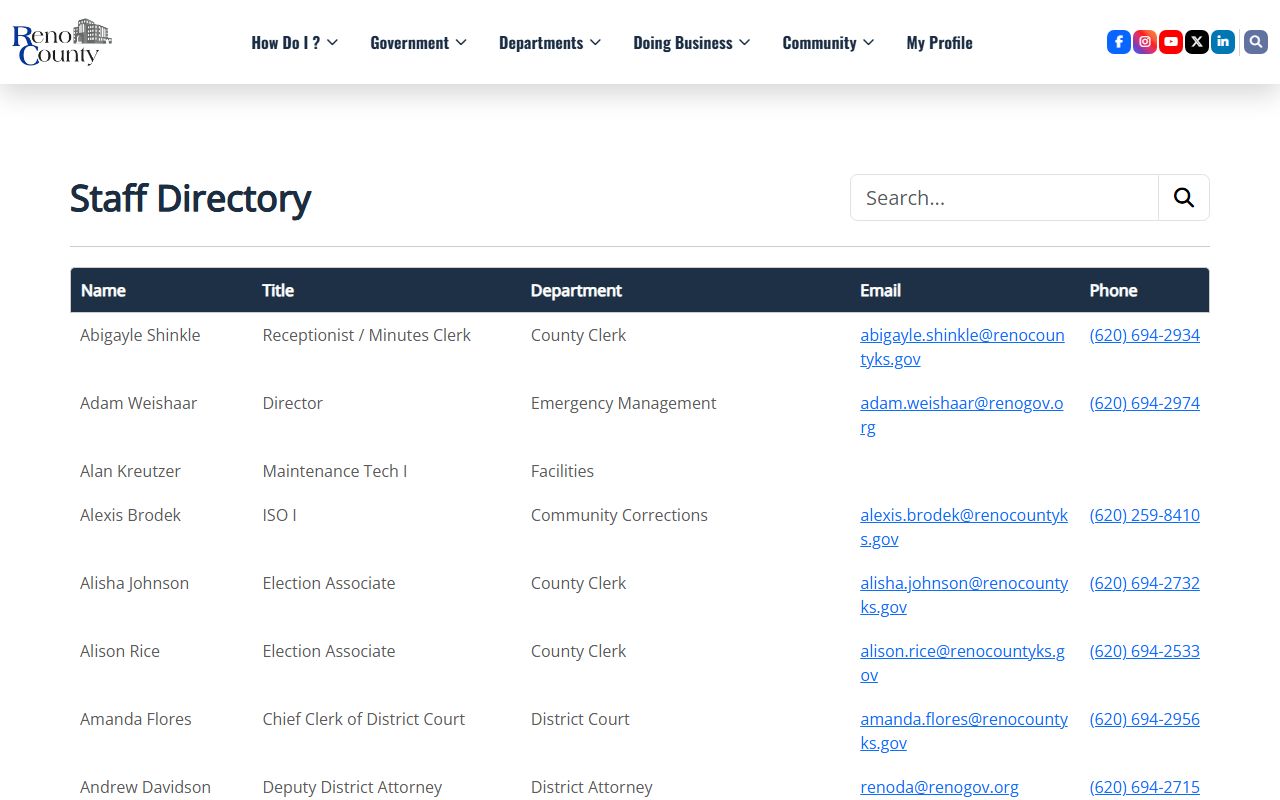
Staff-directory routing matters because criminal records, prosecution questions, warrant questions, and custody questions are not handled by one single counter.
Sealed vs Expunged Records
Kansas law and court orders can limit public access to Reno County criminal court records. A sealed record is blocked from ordinary public view by law or order. An expunged record is restricted through the Kansas expungement process, but that does not always mean every agency copy is physically destroyed or unavailable for every authorized purpose. The safest wording is that expungement limits ordinary public access according to Kansas law and the court's order.
| Sealed | Expunged | |
|---|---|---|
| Public view | Restricted by statute, court rule, or court order. | Ordinary public access is limited after the court grants relief. |
| Who may still see it | Courts, parties, counsel, agencies, or others with legal authority. | Courts, law enforcement, prosecutors, or authorized entities may retain access in some settings. |
| How it happens | By confidentiality law, protective order, juvenile law, or case-specific order. | By filing in the court where the case occurred and meeting Kansas eligibility rules. |
| Reno County path | Ask the Clerk of the District Court what public access, if any, remains. | File in Reno County District Court for district cases, or municipal court for a municipal case. |
Hutchinson Municipal Court's process page includes expungement as part of the municipal court process. District Court expungement questions should be directed to Reno County District Court or counsel. Juvenile, adoption, mental-health, protected-address, and victim-identifying information can have separate restrictions.
Public Access to Criminal Court Records
Public access to Reno County criminal court records comes from Kansas court access rules and Kansas public-record principles, but access is not unlimited. District Court case records use the Kansas District Court Public Access Portal, courthouse terminals, and clerk requests. Kansas Supreme Court Rule 22 controls which electronic district court records and documents are public through the eCourt environment. KORA principles support inspection and copies, while exemptions protect sealed records, certain criminal investigation records, privacy-sensitive data, juvenile records, and other restricted material.
Key Statutes:
Kansas Supreme Court Rule 22 controls public access to electronic district court case records and documents.
K.S.A. 45-221 lists records that may be closed, including certain criminal investigation and privacy-sensitive records.
Kansas Open Records Act, K.S.A. 45-215 et seq. starts from public access unless a law allows or requires closure.
Background Check Considerations
Reno County criminal court records are useful for checking court events, but they are not the same as a regulated background report. A public case lookup can miss sealed cases, expunged records, nonpublic juvenile cases, federal cases, municipal matters, older files, or records that are available only at the courthouse. A full employment, housing, insurance, credit, or tenant screening process must follow the Fair Credit Reporting Act and any other law that governs consumer reports.
Important: Do not use casual court searches for employment, credit, tenant, insurance, or other FCRA-regulated screening decisions.
Official images from the Reno County District Attorney page help confirm the local prosecution channel for state criminal cases.
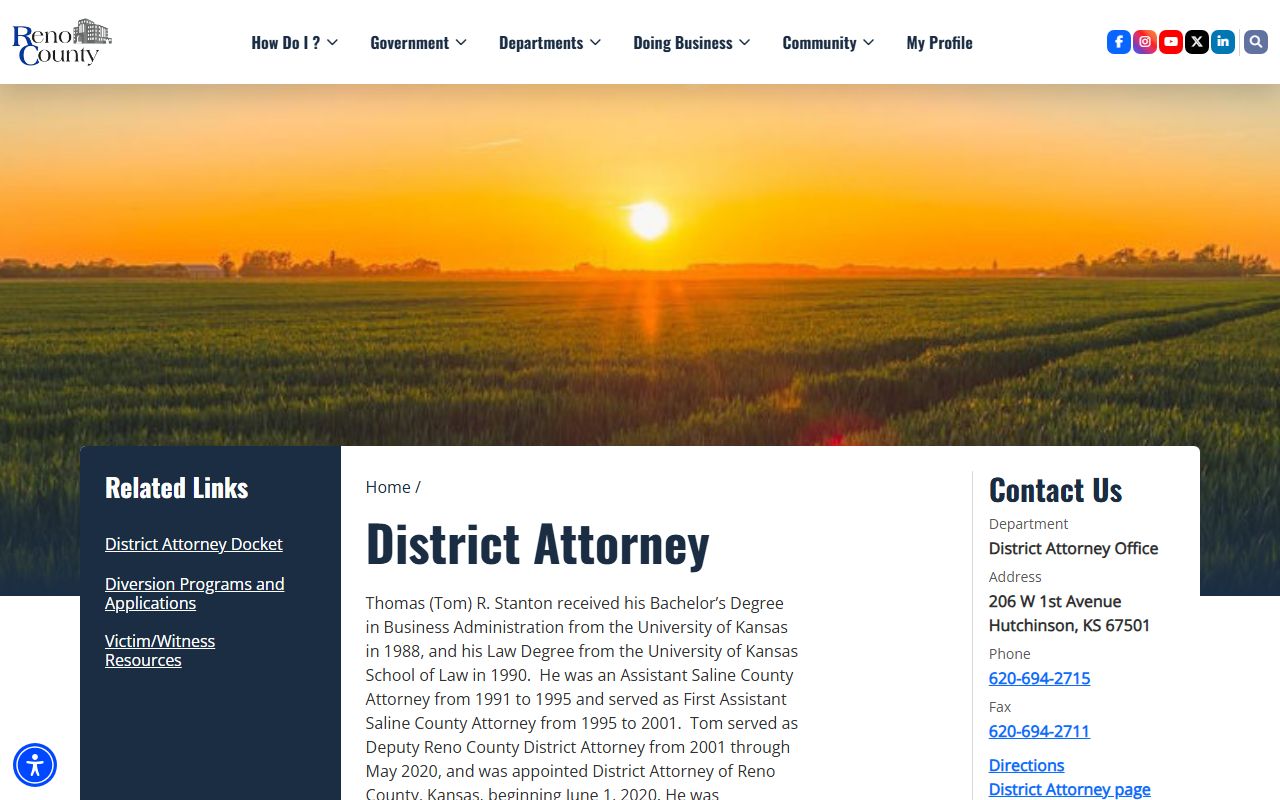
The DA contact is most relevant to prosecution and victim/witness routing, while court-copy questions still go to the Clerk of the District Court.
Restricted Reno County Criminal Records
Several Reno County criminal record categories may be unavailable or partly redacted. Juvenile law enforcement and juvenile court records should not be treated as routine adult criminal records. Adoption and mental-health proceedings are confidential or restricted. Personal identifiers such as Social Security numbers, financial account numbers, minor names, protected addresses, and victim-identifying details may be removed from otherwise public documents. Criminal investigation records may also be closed under K.S.A. 45-221 when release would interfere with an investigation, identify confidential sources, reveal techniques, endanger someone, or identify a sexual-offense victim.
Drug Court material needs careful treatment too. Reno County's official treatment-court news confirms an Adult Drug Court connection, but participation details may not all be public even when the base criminal docket has public entries. Use the court docket for public case status and ask the clerk about document access when the portal does not show a file. Note: a missing online result can mean no public online record, not proof that no case or warrant exists.
The Reno County treatment-court article is the official local source for the Adult Drug Court context.
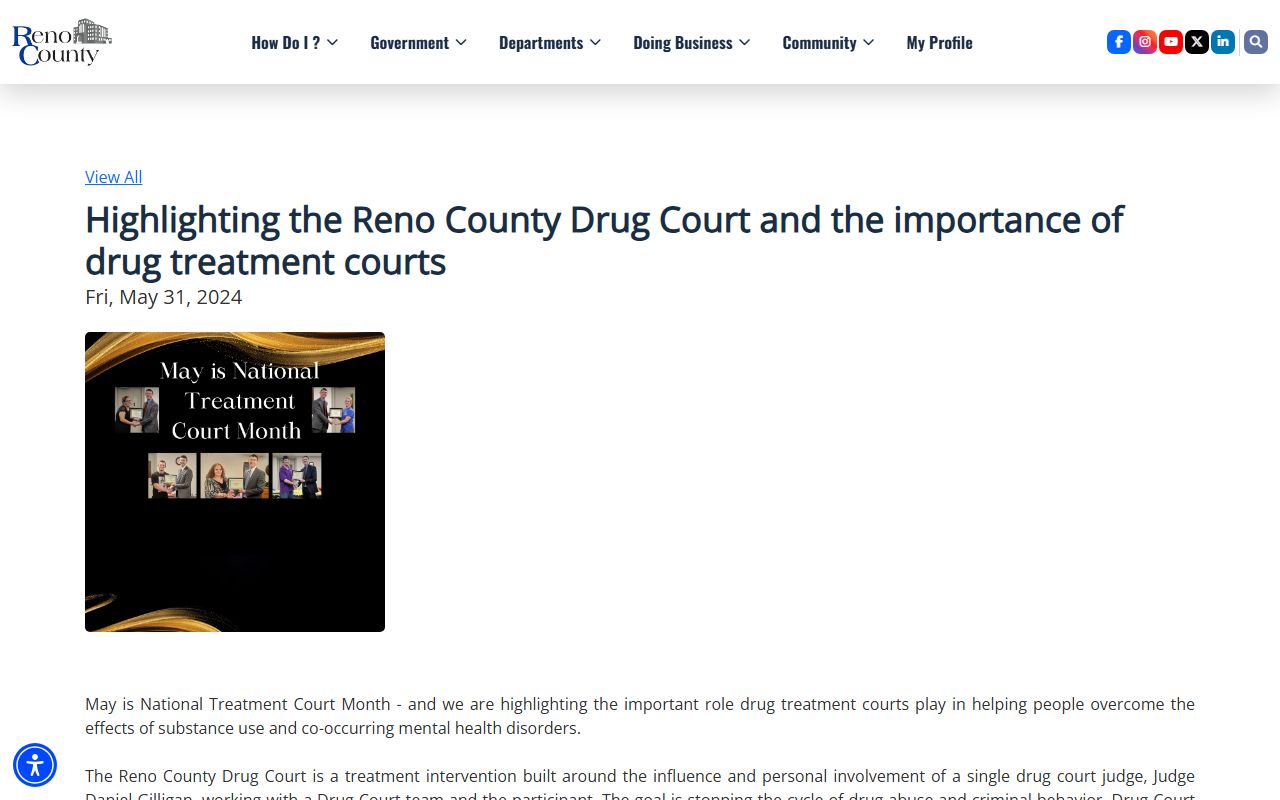
That program context explains why a criminal docket may show treatment-court events in addition to ordinary plea, hearing, and sentencing entries.